DryLab® History
From the fundamentals of reversed-phase chromatography to four decades of releases.
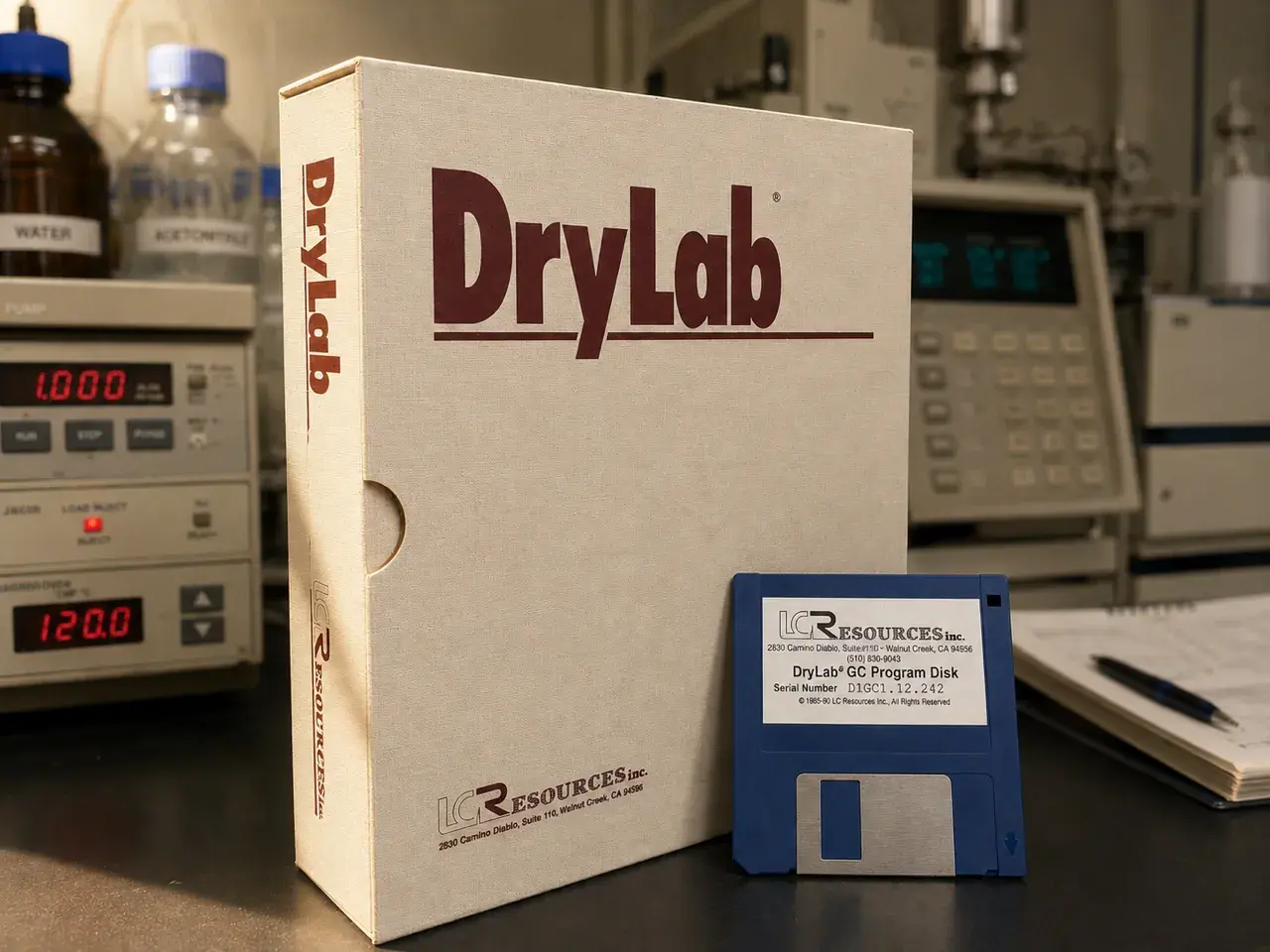
The original DryLab® release from LC Resources — boxed software and program disk, © 1985–90
From the fundamentals of reversed-phase chromatography to four decades of releases.
The original DryLab® release from LC Resources — boxed software and program disk, © 1985–90
DryLab® draws on the philosophy described in the three most famous Solvophobic Theory papers I, II, III of Csaba Horváth, which were developed in the years 1975-1977 at Yale University.
The increasing demand for Quality by Design (QbD) in analytical science is a logical consequence of the often-chaotic method development, that results from a trial and error approach, during which stumbling over new or disappearing peaks in the UHPLC validation process is a common pitfall. To ensure a higher standard of method quality, in 2002 the ICH and FDA started demanding solid and scientific work using Design of Experiments (DoE).
Molnár-Institute has been promoting this type of approach for over 27 years by contributing to the development of DryLab® software through cooperation with LC Resources, under the leadership of Lloyd R. Snyder. Using DryLab®, the systematic and accurate preparation of experiments was initiated, achieving useful and reproducible results. Better peak tracking in DryLab® ensured safe and precise data entry before the model was built.
Designed by UHPLC experts, DryLab®4 offers chromatographers’ unprecedented insight into how a substance can best be separated, and efficiently supports the success of their chromatographic work. DryLab® is the world standard for chromatography modeling in both: method development and training applications.
The following time schedule shows the long and well-documented development history of DryLab® — from the very beginning in 1986 to the essential UHPLC method development tool we have today.
1986
DryLab® LC Simulator
The world’s first HPLC simulation software, originally programmed in BASIC for MS-DOS. Developed by the LC-Resources team, it pioneered computer-aided method development by modeling critical resolution (Rs,crit) against key parameters like %B, tG, T, pH, tC, cIPR and pH. Long before graphical displays, it famously plotted resolution curves and separation windows right on the terminal using MS-DOS asterisks (*)—cutting benchtime by up to 90%.
1987
DryLab® I
Featuring upgraded DOS graphics, DryLab I expanded simulation capabilities to normal-phase chromatography. It introduced column plate number corrections—enabling chromatographers to adjust models for non-ideal scenarios that impact bandwidths.
1988
DryLab® G
Introducing predictive modeling for gradient elution, DryLab G debuted the Gradient Editor feature to easily design, adjust, and multi-segment complex gradient profiles. It also enabled instant recalculation for column hardware changes—such as length, internal diameter, and particle size—allowing rapid optimization of run time, peak capacity, and solvent usage.
1990
DryLab® I/mp
Completely reprogrammed in C for the Windows® 1.0 operating system, DryLab I/mp introduced a wholly graphical user interface with full mouse control. This release expanded existing simulations with restricted multi-parameter capabilities, allowing chromatographers to evaluate relevant parameter effects step-by-step to identify optimal separation conditions.
1998
DryLab® for Windows
The first version featuring true two-dimensional (2D) modeling capabilities, introducing simultaneous optimization of two separation parameters (such as %B–T, tG–T, %B–CIPR or pH–cbuffer). This landmark release allowed chromatographers to explore multi-variable parameter interactions on a single, comprehensive resolution surface (heat-map), mapping out robust operational regions while dramatically accelerating method development turnaround.
2000
DryLab® 2000 and PeakMatch®
Upgraded for Windows 3.1 and later Windows XP, this was the first version released in C++. The Peak Match versions introduced peak-tracking, streamlining the necessary manual alignment of peaks across different input chromatograms to reduce errors and significantly boost laboratory productivity.
2006
DryLab® Acquisition
DryLab was acquired by the Molnár-Institute, moving software development to Berlin, Germany. Led by Dr. Imre Molnár, this transition focused future development on multi-dimensional modeling and aligning software workflows with modern Quality by Design (QbD) standards.
2009
DryLab® 3.9 and DryLab® 2010
Introduced "3D Cubes"—three-dimensional resolution mapping enabling the simultaneous optimization of 3 critical parameters (such as tG, T, tC and pH). This major advance allowed chromatographers to visualize complex multi-variable interactions within an interactive 3D Design Space, establishing a comprehensive, Quality by Design (QbD)-compliant approach to method development.
2012
DryLab® 4
The first version re-engineered in C#, featuring a modern, user-friendly window management system and an upgraded 3D Cube engine. Compatible from Windows® XP through Windows® 11, this release delivered enhanced graphics rendering, smooth multi-window navigation, and long-term OS stability for enterprise laboratory environments.
2013
Robustness and Knowledge Management Modules
Introduced the Robustness Module for in silico quantification of prospective method performance, allowing chromatographers to evaluate method stability against experimental variability before routine execution. This update also added a dedicated GMP-compliant reporting module, enabling automated generation of audit-ready development reports to streamline regulatory documentation and method transfer.
2017
Column Comparison Module
Launched a systematic comparison tool allowing side-by-side comparison of 3D Design Spaces across different stationary phases. This milestone replaced traditional column characterization methods with a modern, Quality by Design (QbD)-compliant methodology—enabling chromatographers to select equivalent or alternative columns based on true, multi-parameter separation behavior.
2019
Waters Empower Automation Module
Developed a new software connectivity module for Waters Empower CDS, enabling automated dataset creation and retrieval across software layers. Featuring one-click data transfers, this seamless integration eliminated manual transcription errors, streamlined experimental workflows, and significantly improved overall laboratory productivity.
2024
Design Space Comparison Module
Replacing the earlier Column Comparison Module, the new DSC enables direct 2D and 3D comparisons of entire separation spaces. This advanced module allows chromatographers to tackle frequent chromatographic challenges—such as column interchangeability, batch-to-batch stationary phase reproducibility, and buffer replacements—while seamlessly assisting method transfer between different instruments and laboratories.
2026
New Automation Module
Featuring a freshly polished, modern user interface, the new Automation Module unifies connectivity for both Waters Empower and Agilent OpenLab CDS platforms. This streamlined integration provides a cohesive workflow for automated dataset creation and multi-layer data retrieval.