Eastern Analytical Symposium
Nov 16 – Nov 18, 2026
Crowne Plaza Princeton – Plainsboro, New Jersey, USA
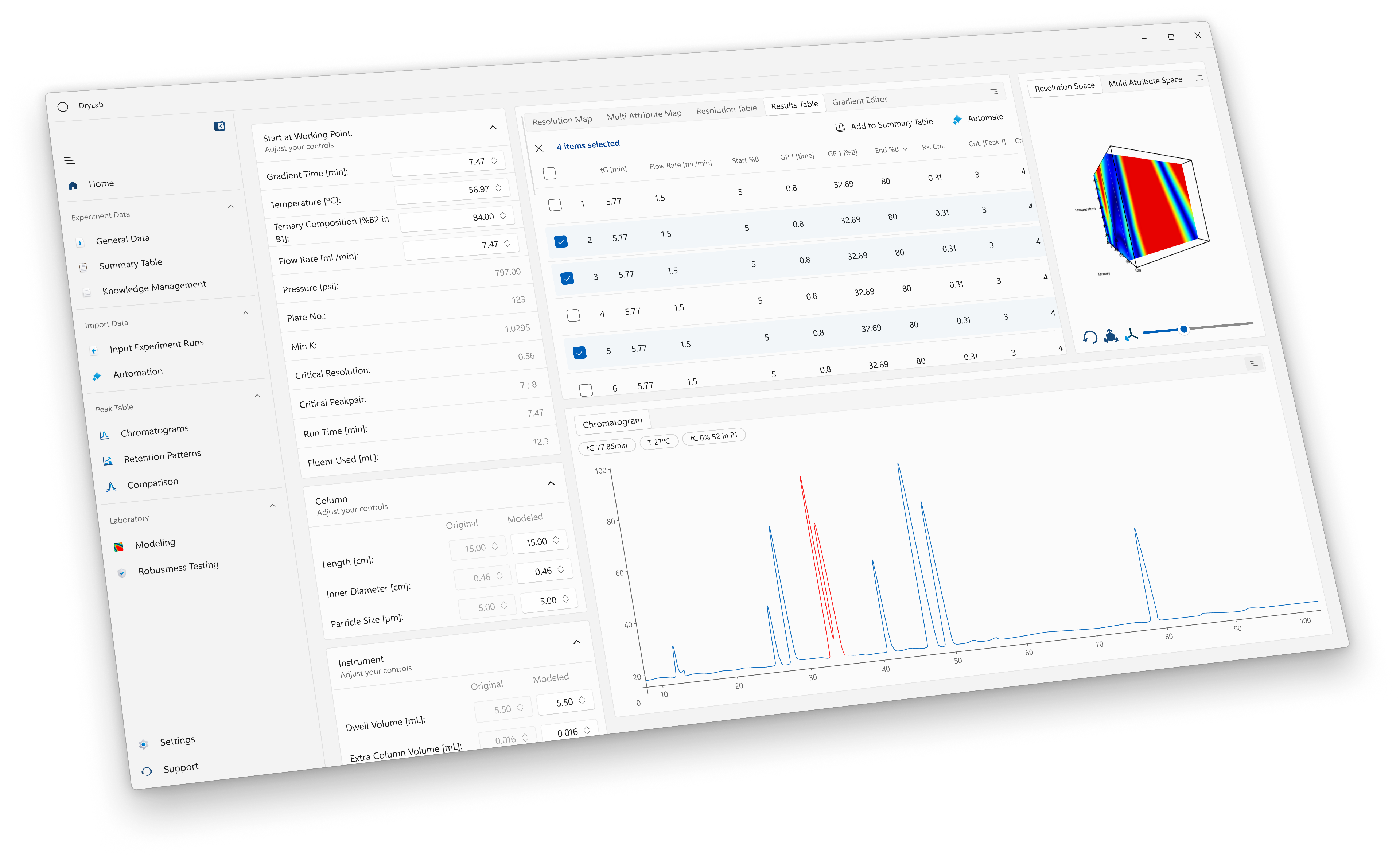
DryLab® Analytical Design Space Modeling predicts retention and resolution as separation conditions change. Identify robust operating ranges within which your required resolution is maintained.

Explore Your Design Space. Run Fewer Experiments.

Characterize Your Separation Systems and Quantify Parameter Effects.

Determine Separation Limits. Identify Proven Acceptable Ranges (PARs).

Put ICH Q14 and AQbD into Practice with DryLab®.

Make Validation and Transfers More Predictable.
Developed by chromatographers, for chromatographers.
From typically no more than a dozen input experiments, DryLab® Analytical Design Space Modeling builds an accurate digital model of your sample’s chromatographic behavior. Predict retention and resolution across the modeled design space, identify conditions that meet your separation requirements, and define robust operating ranges — without testing every combination in the laboratory.
Explore digitally. Free up instrument capacity for the other work you need to get done.
99,4%
retention-time prediction accuracy ¹
Up to 40x
faster analysis times ²
Up to 12x
faster method development ³
I have been using DryLab since my PhD studies and continue to rely on it in my current role at Bayer AG. DryLab allows us to efficiently predict retention behavior and assess the impact of changing compound mixtures, significantly reducing experimental effort during method development. Its strong scientific foundation, based on established chromatographic models, delivers reliable results, while the software continues to evolve with valuable new capabilities. Beyond its practical benefits, DryLab is also an excellent learning tool, backed by a highly responsive and knowledgeable support team.

Ryan Karongo, PhD
Senior Scientist, Oligonucleotide and Peptide Analytics
Bayer AG
We have relied on DryLab as the leading software for HPLC method development through simulations and modeling since our collaboration with Dr. Imre Molnar began in 1996. Over the years, DryLab has enabled us to develop robust, optimized gradient elution methods with remarkable efficiency. Its intuitive, user-friendly workflow empowers our team—especially those new to HPLC—to confidently design high-quality methods in just a few steps, eliminating the uncertainty often associated with conventional trial-and-error approaches. DryLab significantly reduces development time and solvent consumption, making HPLC method development faster, more cost-effective, and environmentally sustainable. We highly recommend DryLab to any laboratory engaged in HPLC gradient method development.

Professor Michael Lämmerhofer
Professor of Pharmaceutical (Bio)analysis
Universität Tübingen
I have used DryLab for many years across two different pharmaceutical companies. In my experience, DryLab has helped transform traditional trial-and-error method development into a Quality by Design approach aligned with current regulatory expectations. It provides valuable scientific insight, improves development efficiency, and has become an essential tool for robust UPLC method development.

Cristian Steiner
Analytical Development & Quality Testing Manager
Basilea
I've used DryLab for 10 years as an integral part of my approach to HPLC method development in pharmaceutical development, from early-stage drug candidates through late-stage programs. I have found it particularly valuable for challenging separations involving large, structurally complex small molecules with complicated impurity profiles, including methods where as many as 30 individual peaks needed to be separated. DryLab enables me to explore a much larger chromatographic design space than would be practical experimentally and, importantly, to better understand the factors driving selectivity between closely eluting components. For complex impurity profiles, this ability to model and visualize how changes in chromatographic conditions influence the entire separation can be extremely powerful. That capability is valuable throughout the stages of pharmaceutical development from rapidly identifying effective separation conditions for early-stage candidates to developing increasingly robust and well-understood methods as programs advance. DryLab helps me make more informed development decisions, reduce trial-and-error experimentation, and build greater confidence in method robustness. For me, DryLab is a powerful platform for understanding complex separations and supporting scientifically driven method development decisions.

Ashley Banks
Principal Scientist, Analytical Development
Kymera Therapeutics
DryLab® optimizes the development of complex LC methods through an efficient, resource-saving approach. With only a few LC runs, robust methods can be reliably predicted, while robustness can be estimated without additional experiments. The software enables comprehensive method lifecycle management and allows flexible adjustment of LC method parameters within the design space without further experiments. The established design space is indispensable for a successful method transfer. Overall, DryLab® leads to significant savings in resources, time, equipment, and materials.

Ralf Hohl, PhD
Head of Laboratory
Sanofi
DryLab is an essential part of our HPLC method development process at Promega. Our analysts can quickly transition from their initial screening pass into DryLab, where the visualization of method parameters in 2D and 3D allows us to move the method into a robust and operable space. Before DryLab, we could not easily tell if a method was close to a failure point. By visualizing the model space, we can see these points clearly and adjust. The ability to simulate separation changes across a range of gradients, temperatures, and other parameters has decreased the time it takes us to develop a method. […]
DryLab is very helpful when we transfer methods from development to quality control. Design space visualization and robustness information provided by DryLab give us something we can share with our quality teams that we didn’t have before. This information gives our QA and QC teams confidence in the method.
The support from the DryLab team has been outstanding from the beginning. When we were evaluating different options, they worked closely with us, using data from our lab, to show all the features of the software and its benefits. Compared to other software we tried, DryLab is intuitive and easy to use for chromatographers with different levels of experience, and it stays focused on HPLC method development. After adoption, personalized, in-depth training sessions gave my team confidence to use the software right away. Since then, whenever we need help working through a model or have a problem, the DryLab team has been very responsive. They want to help us succeed. Their depth of experience and focus on customer support set them apart. We look forward to working with DryLab for many years to come.

Joshua Kimball
Senior Manager, Analytical Chemistry
Promega Corporation
As a pharmaceutical service provider for AQbD-based method development and validation, Chromicent has successfully managed to keep ahead of the scientific and regulatory curve. One reason for this is our usage of DryLab® [...] it reduce screening and evaluation time drastically while ruling out any transfer errors by means of automation. More so, DryLab® helps us provide customers and regulators with information necessary to understand complex chromatographic behaviors. In addition, by using DryLab®, we fully comply with what ICH guidelines Q8, Q9, Q10, Q12 and Q14 expect.

Alexander Schmidt & Mijo Stanic
Founders
Chromicent
The use of hyphenated liquid chromatography-mass spectrometry (LC-MS) techniques has been supporting my research activity in the field of Analytical Chemistry. In most analytical challenges, I relied on high-resolution mass spectrometry (HRMS) as the primary separation domain, thus considering liquid chromatography as a simple support to HRMS-based detection. But what if your analytes are isomers with just slight structural differences? What if non-isomeric compounds share the same ionization channels due to in-source fragmentation phenomena? What if isomeric species exhibit minor differences in their complex fragmentation patterns? This is where HRMS faces its limits and the use of the chromatographic dimension becomes essential.
Whoever has a poor background in the field of chromatography and experimental design would rather choose a trial-and-error approach to improve the quality of the chromatographic separation. However, this can easily lead you to a negative spiral fed by waste of time, mental effort, and chemical resources. While I was facing the complexity of such an analytical scenario, I attended a talk by Dr. Imre Molnár focusing on DryLab. I came to their booth to get more information, and everything has changed since then.
[…] DryLab is your life jacket if you are drowning in the middle of desperate attempts to improve the quality of your chromatographic separation. With just a limited number of scouting experiments, the software allows you to optimize the quality of the separation with high accuracy in retention time prediction. Moreover, the use of the software improves the knowledge of your system, highlighting how the interaction between different factors (e.g., gradient steepness, column temperature, and the chemical composition of the mobile phase) can affect the quality of the separation. The use of DryLab also represented a learning opportunity in the field of chromatography due to a constant and fruitful scientific exchange with members from the Molnár Institute. Overall, DryLab is a must-have tool that boosted the quality and reliability of my scientific results. […]
It is often fascinating to observe how technological improvements in the field of separation science (e.g., ion mobility spectrometry, two-dimensional liquid and gas chromatography) can also push the research towards increasingly ambitious challenges. But it is also wise to ask yourself a simple question before trying to improve your lab instrumentation: did you really get the most out of your LC system? You should ask DryLab first.

Andrea Castellaneta, PhD
Postdoctoral Researcher
Università degli Studi di Bari Aldo Moro
DryLab has been central to my HPLC and UHPLC method development across research and industry for over 15 years. Having evaluated the platform's newest capabilities firsthand, I’ve found it consistently harmonizes scientific rigor, practical industry needs, and regulatory compliance. For analytical scientists seeking straightforward method development and deep chromatographic understanding with minimal investment of time and resources, DryLab is the absolute benchmark.

Róbert Kormány, PhD
Senior Structure Determination and Chromatography Expert
Egis Pharmaceuticals PLC
As a Contract Research Organisation (CRO), Quality Assistance provides regulatory, scientific and technological expertise to large companies and SMEs in the pharmaceutical industry. Customers around the world rely on us when developing and marketing innovative human medicinal products in compliance with European and US regulations — also because we constantly invest in the most sophisticated technology and equipment. DryLab®'s Empower™ and OpenLab automated Design Space Modeling allows us to streamline the development of analytical procedures, both for small molecules and biotherapeutics. Knowing that our methods are optimised in a way that makes them robust for their subsequent use in any QC environment is a key reason why customers turn to us in product developments from discovery to the market place.

Arnaud Delobel, PhD
Director R&D
Quality Assistance S.A.
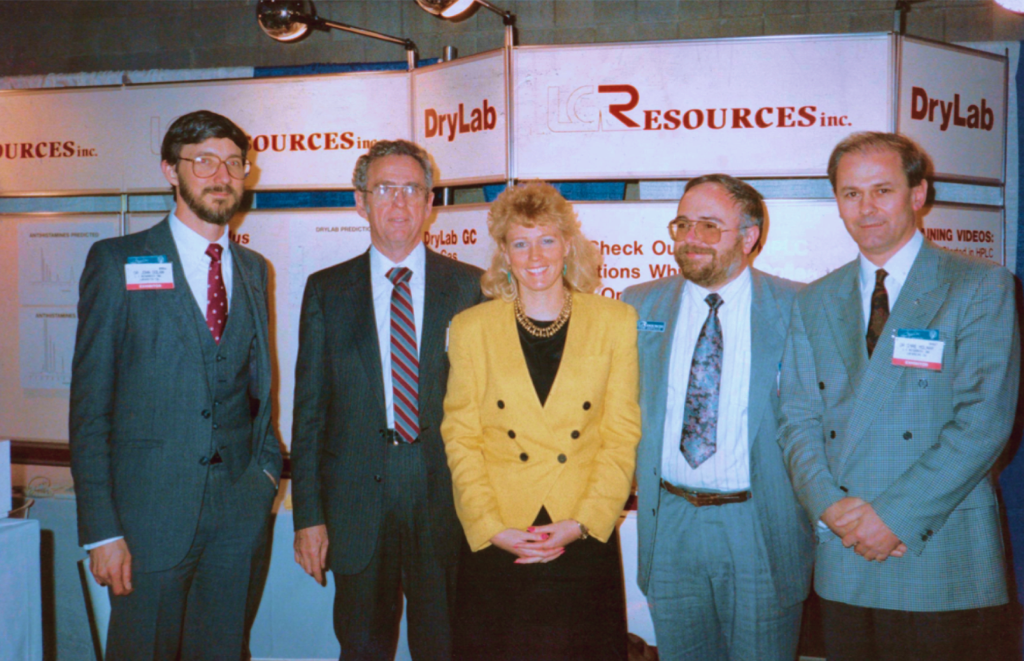
DryLab® brings decades of chromatographic research and method-development experience to your laboratory. At the MOLNÁR-INSTITUTE, we develop the software and help you apply it to your own separation challenges—from design space modeling and optimization to robustness assessment and method transfer.
40+ years
in chromatographic modeling
2 scientific awards
recognizing contributions to chromatographic theory and practice ⁴˒⁵
280+
peer-reviewed publications on the application of DryLab